

The most effective weapon any company can use but most choose to ignore
Why Humblebee CEO Russell Clark is more bullish than ever about co-ventures and all forms of spin-outs.


What weapon am I referring to? I'm talking of course about the ability to build ventures from inside your corporation.
Already I can hear the groans. Just the mention of 'venture building' will immediately scare away the majority of leaders & senior managers in businesses of all shapes and sizes. Perhaps it's a term charged with pre-conceived ideas? "Venture building is something for start-up folks! It’s not for the likes of us! We have a core business. We do CORE things! Serious... industrial... manufacturing... machine... things”.
And I understand.
It can be tough to see possibilities.
Especially when you don't look.
The irony is the industrial, B2B companies here in the heart of Sweden (the ones I have called my client base for almost 20 years) are exactly the ones who have the most to win...
So bear with me. Even if you don't want to, or are 100% unable to create new stand-alone business entities, the process itself is incredibly valuable for you & your staff regardless. And there are many flavours of ventures available, stopping short of creating a new limited company.
The definition of corporate venturing:
Creating new ventures within an established company, allowing the company to explore new markets and business models while leveraging its existing resources and capabilities and at the same time benefit from startup characteristics, such as agility, speed and access to talent. This approach can provide corporations with an advantage over their nearest competitors, and of course any noisy upstarts.
There's all kinds of ways to define corporate venturing. The definition above originates from the good people at Pioneers with a couple of tweaks. "Leveraging existing resources and capabilities" is key here.
What will you do with your unrealised commercial potential?
You have great people at your company. Especially in the deep, complex industrial product companies, where knowledge of your tools, your customers problems & situations is in the blood of your workforce. You must capitalise on this intellectual property whilst they are still in the building. A blood transfusion, so to speak. 😊 They won't do it by themselves, they are likely not incentivised to do so.
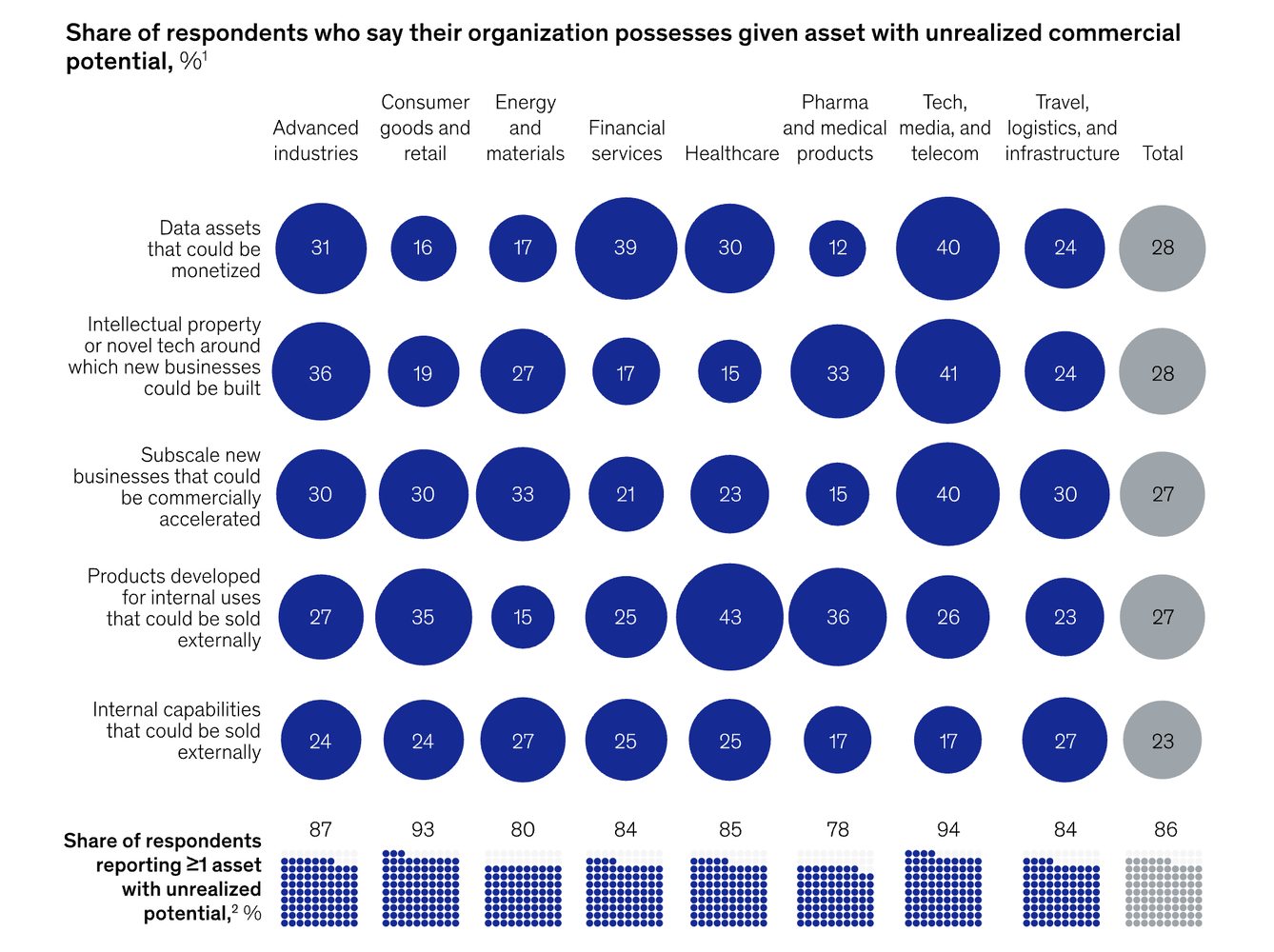
A recent research survey from McKinsey highlighted the unrealised commercial potential across a range of industries.
Unable to build a stand-alone company?
No problem. There are other strategic moves.
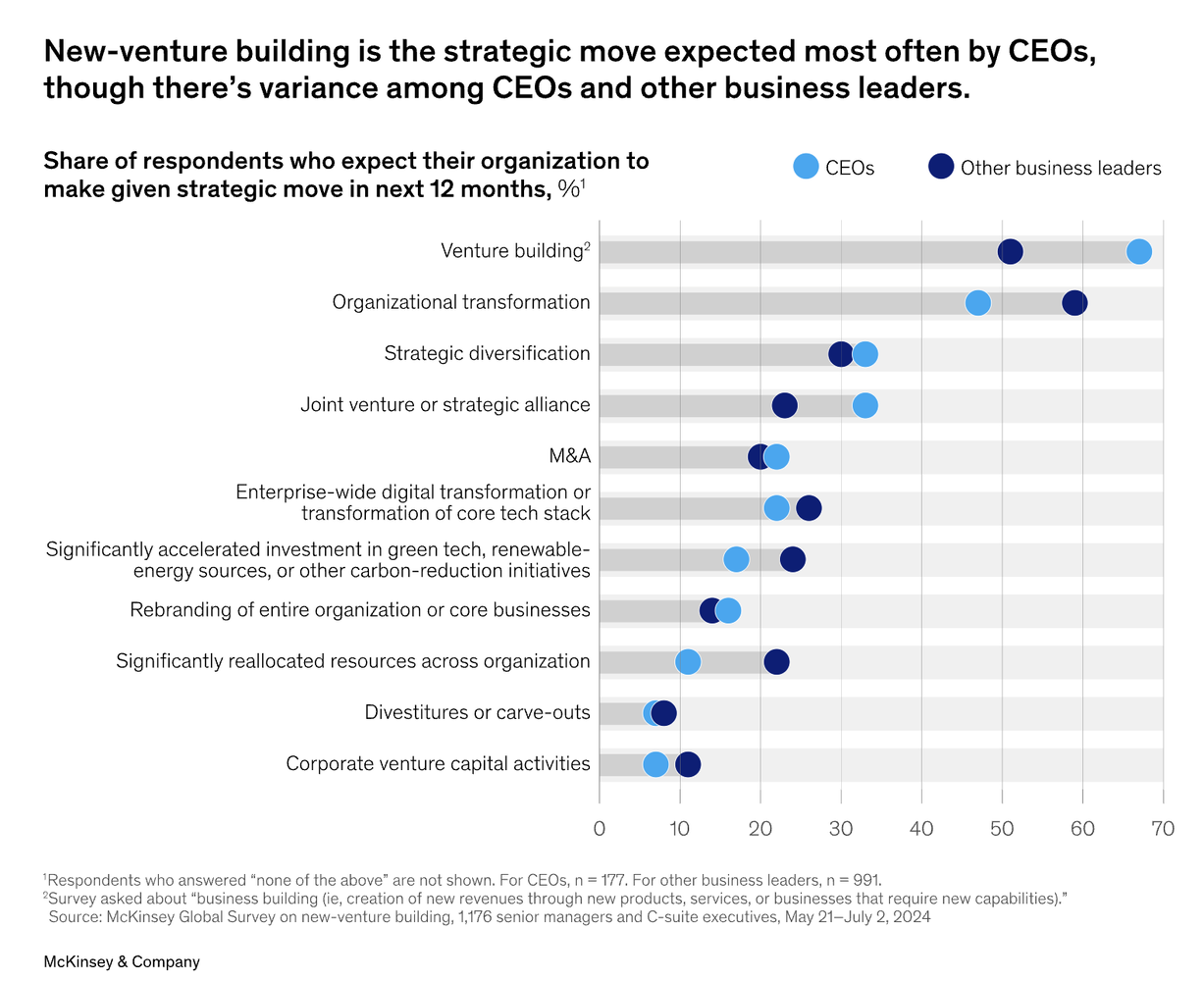
You may not be able or willing to create a so-called spin-out venture. A stand-alone external business entity might simply be a non-starter. You might not have the mandate. But have no fear, the same report by McKinsey shows the top strategic moves expected by CEO's. Ventures, but also organisational transformation and diversification rank high. So how do you prove your worth as an ambitious senior leader? You can ensure these strategic transformations take shape.
There are many reasons your specific company may not be in a position to even TRY to aim for spin-outs or stand-alone new business ventures. However the benefits of the process of venture creation make it a worthwhile journey for your company to embark upon.
The process makes the journey financially valuable
Let's say you DON'T want to create a stand-alone venture, but you DO need to 'transform' or find strategic diversifications. I would quietly predict this is 90% of the managers and senior leaders reading this by the way. That means you need to get that engine of strategic innovation running. The motor that will get you scouting for strategic diversification opportunities...
In that case, following the venture building process is of extremely high value.
The concrete results of a corporate incubation program
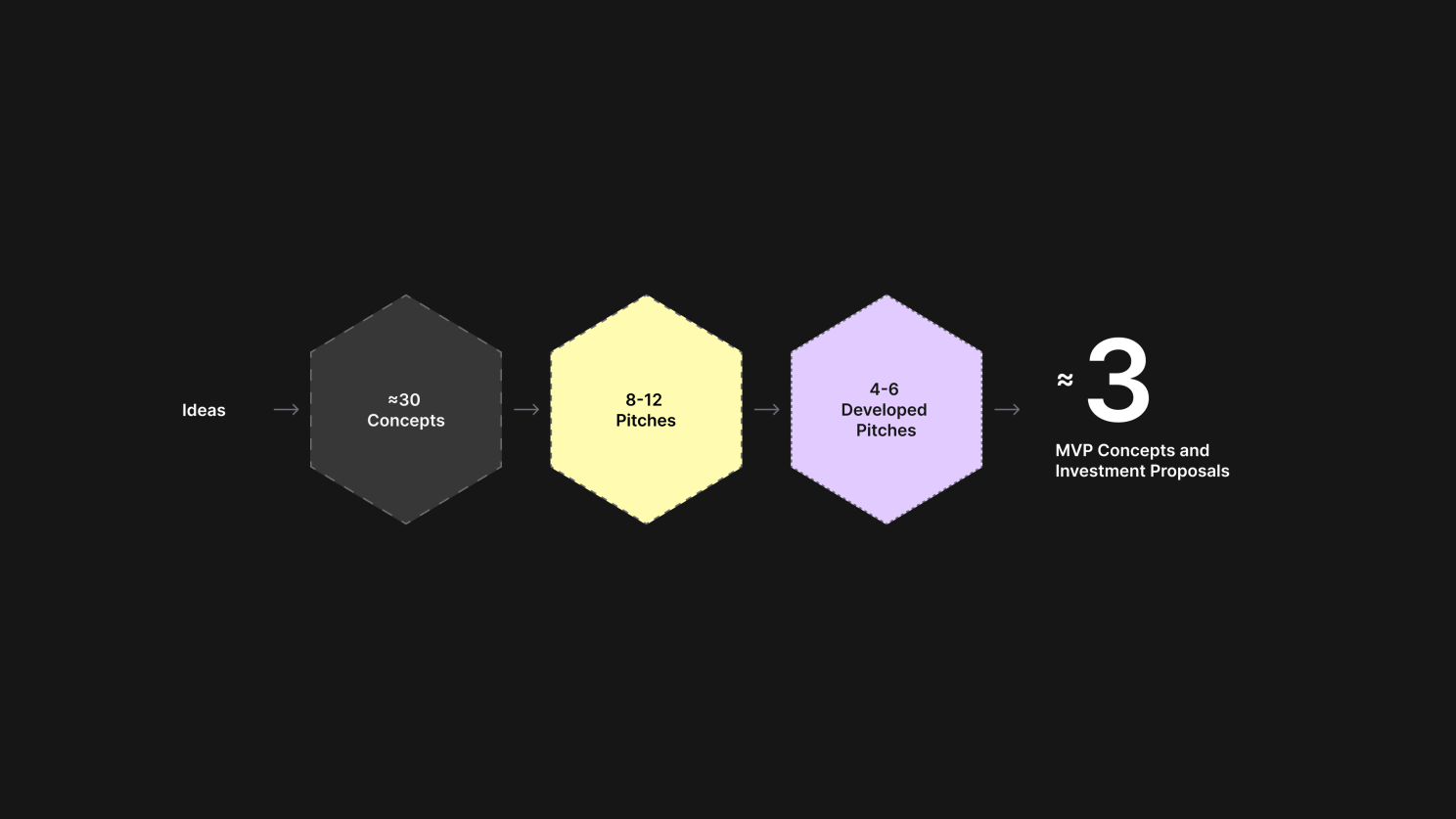
This simplified diagram below is a realistic set of outputs from a few months in a corporate incubation program. The processes involved in the "how", the finding the strategic opportunity spaces, ideas, concepts etc are topics for another time, but the moral of the story here is simple:
- Find and validate many concepts quickly.
- Turn them into pitches.
- Let the winning pitches be developed and validated even further.
- End up with 3 validated MVP concepts and water-tight investment proposals.
The length and exact output from your program will depend on many factors, from the skills of your team and the starting point of any ideas or product concept hypotheses, to the ability of your governance (presumably c-level leadership) team to help you with your "Go / No Go" decisions for any concepts.
With your governance team in place, you can set up a competent, multi-disciplined Discovery Team. In X weeks, you can take a Go / No Go decision on X amount of strategic concepts & ideas. High and low. You can power through an abundance of ideas in a short space of time when the simple, but chronically difficult to achieve, parameters are: prove me the value of this service and we will unlock further investment... If you can't, we won't.
Just a few benefits you will see see from following the process for corporate venture building:
- You will constantly monitor your own industry and related industries for threats & opportunities.
- You will up-skill and stimulate your existing staff in many ways.
- Your staff will be involved in incubating THEIR innovative ideas & suggestions. (Quickly & efficiently).
- Your staff will be drilled in a way-of-working that more represents a venture-capitalist's process. Value must be proven to unlock any further investment. This is vital training for the challenging times ahead...
- Your company will attract exciting new tech and engineering talent, regardless how 'fashionable' your industry or brand legacy may be.
- Embracing the process of incubating new digital products and services 'en-masse' will result in many failures*. But also a success or two...
- Today's technologies allow the entire process above to go quicker than ever! There is literally no excuses left for inaction.
*There really are no failures. Poking the market and finding out if they are interested in Service X is valuable customer feedback. Do it often. See the benefits.
🦄 You may not find the next unicorn SaaS product, but that's not the point. We're not hunting unicorns here. We're sure you'll uncover a multitude of new services, tools or improvements resulting from a focused incubation program.
Incubation Process in more detail
A lean and cost-effective set-up for product incubation
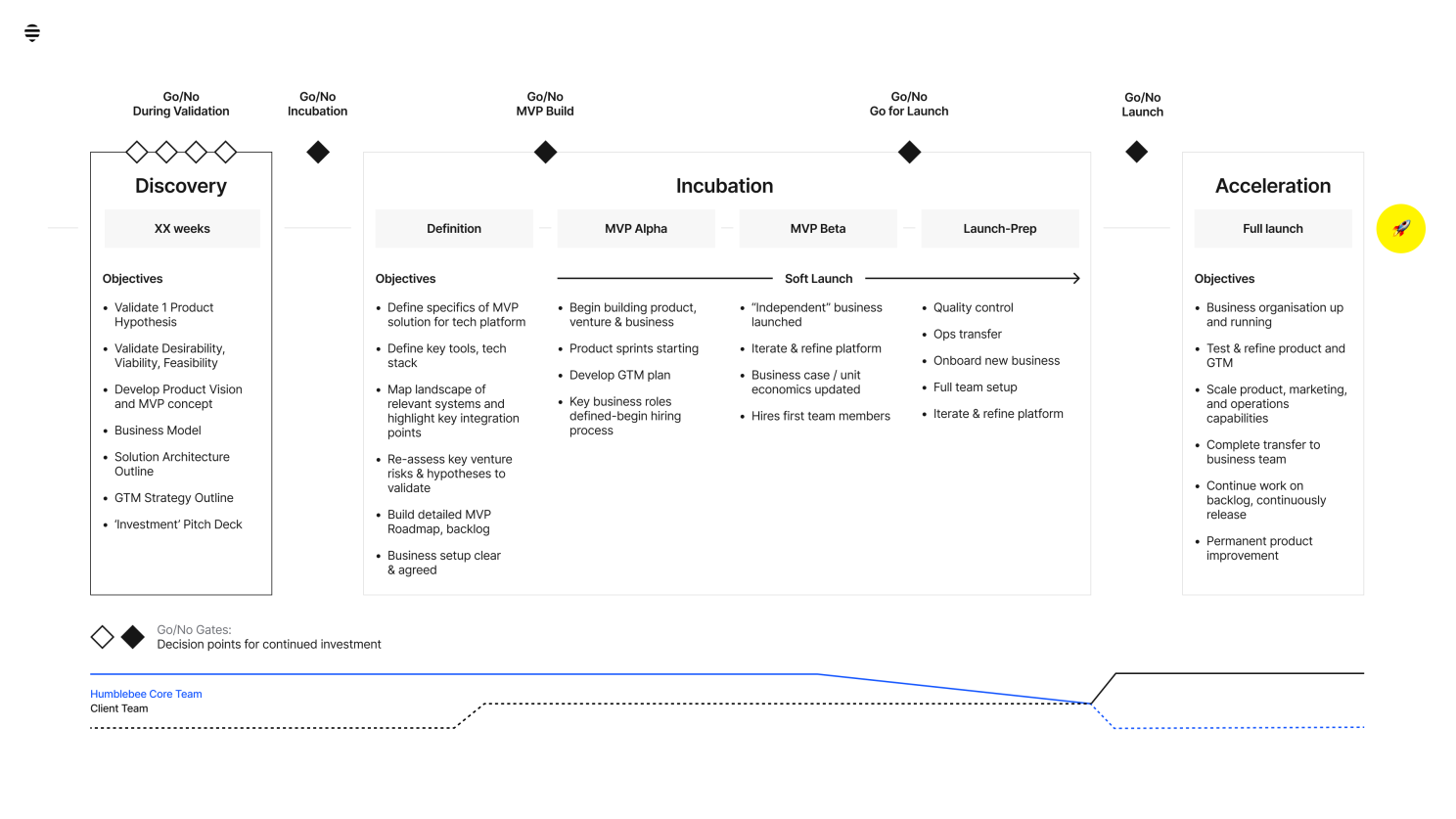
Below is a rough outline of a product or service incubation process a la Humblebee, for one product or service. This takes you from one product hypothesis through to a launch, including a GTM outline.
You don't need a HUGE, scary budget to get started. You don't need endless amounts of administrative or project leading staff involved. Just a small gang of multi-disciplinary talents who are drilled in a pro-active, problem-solving mentality. And who understand their arse is on the line to find further 'investment' for the concepts they uncover and bring to life...
Pay attention to the attrition level at the bottom. Humblebee act as a core team, but we really want our clients to employ and find the absolute best talent to replace us. When services leave the incubation oven, Humblebee even help our clients find and employ the right talent to maintain and accelerate services post-launch!
Finally... venture building is not just for giant companies
Use this process to outfox competitors
The same McKinsey report mentioned earlier obviously highlights the best case studies from (large, global) companies, sharing impressive statistics like "the ten largest new ventures built by established companies in the past decade have averaged 1.5 times more revenue than that of the largest start-ups launched in the same period". And that's all well and good...
... but YOU can follow the process too.
What do you have that start-ups and your competitors do not?
This is just a very quick diagram... You are the left circle. You have all the fantastic people, IP, a proven salesforce, industry knowledge, experience, established brand... etc etc etc etc... Plug that in to the right circle and watch magic happen. You have the infrastructure, skills and reputation to outfox any impudent start-ups in your industry, but building the set-up below will help you move faster than your nearest competitors.
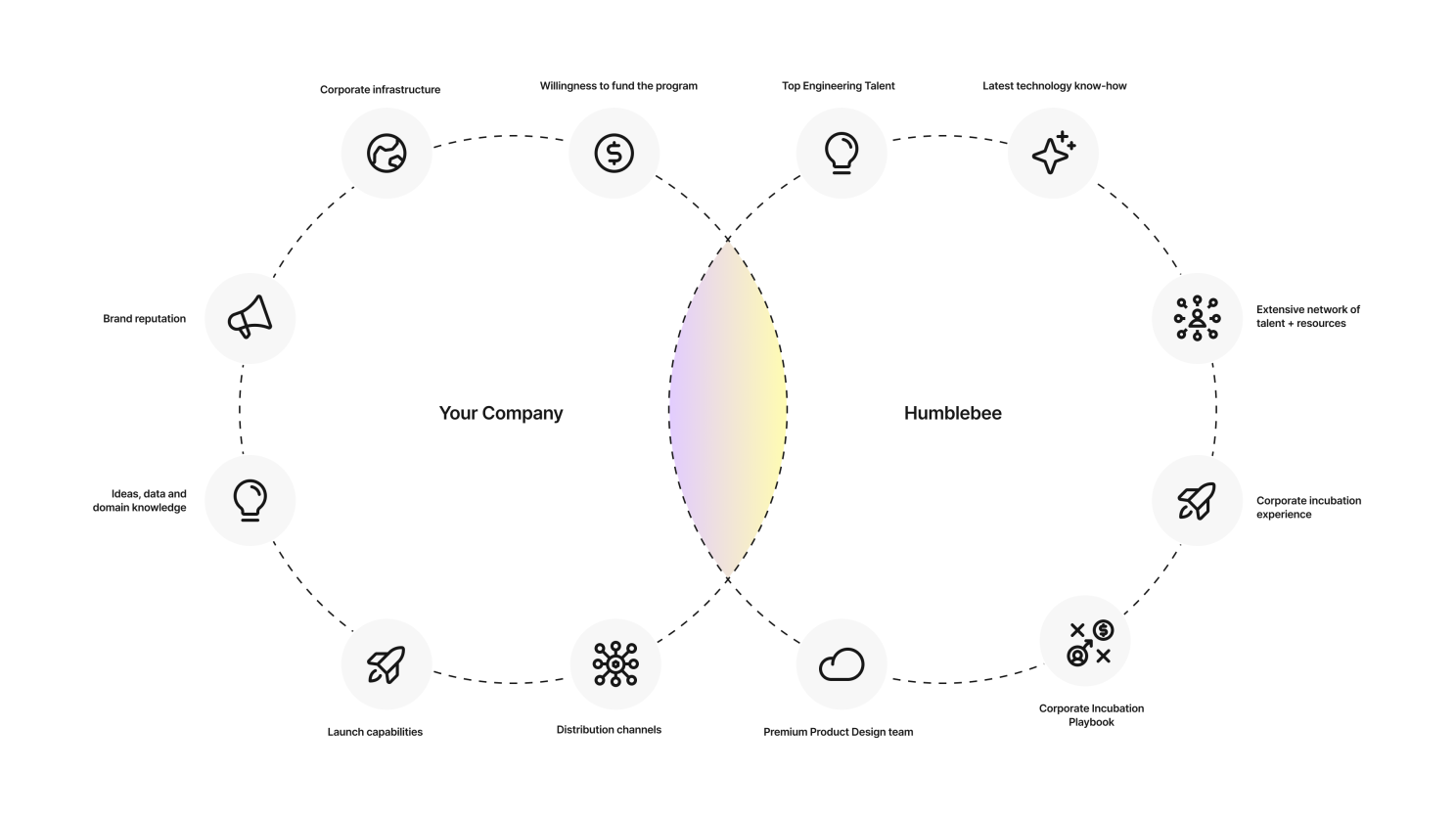
You can deploy all the advantages startups or smaller competing companies may have and leverage the assets and intellectual property you're already sitting on.
Wrap it up Rusty
That turned into somewhat of a rant. I'll wrap it up.
In summary, corporate venture building is a fantastic driver of growth for companies, of all shapes and sizes. The evidence is there that investing strategically in new ventures reaps substantial rewards. The current maturity of the tools, technology and ways-of-working now make these opportunities accessible to all - irrespective of size, industry or legacy.
Even if the goal of creating a stand-alone venture is not for you, the process of trying to get there will bear enormous amounts of juicy fruit!
Good luck!
/R
More stories


